 Yusheng
December 6th, 2022 By Atinuke Olaleye, Yusheng Ding
Table of Content
Introduction
Green Cycle is a recycling app and an information resource about climate changing for university students. The aim is to both improve university students' welfare and form their recycling and environmental awareness habits.
First, because we ourselves are university students, we come with a nuanced perspective to understand the needs and goals of university students. University students tend to have financial stress and limited time for their life, and this recycling app carefully takes these into consideration during the design. This app does not solve these issues directly, but rather reduces their burden to a certain extent. Meanwhile, the app helps the student to be aware of the climate change and environmental impact through social media competitions, actionable tasks and information prompts within the app to form their habits of garbage recycling and trading second-hand items eventually.
Secondly, we strongly believe that university students will soon seek jobs in research, education, law, or engineering, among other fields; as a result, they must be aware of the effects their professions have on the environment in general and the climate in particular. According to Morgado et al. (Morgado et al., 2017), higher education institutions should "adapt curricula, general teaching and evaluation approaches to foster a desirable growing of the willingness-to-change behaviour related to CC [Climate Change] and its impacts on the environment and socio-environmental and climate governance". While the higher education institutions help university students increase their awareness, information apps with information and benefits of knowledge on climate change with regards to the parts students play, can further increase the level of their participation in climate change efforts. In other words, having an information service that educates them while encouraging habits that prompt students to be aware of the environment is crucially important. Furthermore, by educating university students, their habits can benefit future generations when they consider climate change in their professional fields.
Product information
Green Cycle mainly consists of three major parts and with a few addon features to enhance the product in different ways.
Here is the link for Figma file.
Major Components
Nearby Recycling Facilities
This component is the main page, and it is designed to help the student to find their nearby recycling facilities through public information, such as Google Maps and Apple Map. Like other map apps, it displays the user in the center of the map with pinpoints of the nearby recycling facilities. The pinpoint not only serves for displaying the location of the facilities, but also displays the general price for one particular type of item (e.g. electronics, furniture, clothes, etc.). This part learns from the gas price checking feature from Google Maps. The user can view the price for different types of item by clicking the desired particular type in a category dropdown. This could help the user to compare the prices among the facility to get the best deal for the recycling item and the location of the facilities.
Second-Hand Advertising
This part of the app allows the user to post "Want to buy" (abbr. WTB) and "Want to Sell" (abbr. WTS) advertising to allow peer-to-peer second-hand trading. For effective information seeking and retrieval, The users can search for the desired item through a search bar, and the items are also categorized with labels (e.g. electronics, furniture, clothes, etc.). The user could also see the pictures of items and the asked price for each item.
Education Component -- Climate Change Information
This part is an education component that provides knowledge of climate change. We have to define what is climate change and its emergency level.
Climate change is an ongoing disaster. According to United States Geological Survey (USGS, n.d.), every continent of the earth is impacted by the long-term effects of climate change at a significant level, such as lower snowpack and more frequent heat waves in North America, less freshwater in Asia, loss of biodiversity due to less tropical forest in Latin America and increased exposure to water stress in Africa. All of these have direct impacts, such as food shortages and natural disasters, on the sustainability of every country in the world.
According to a study assessing university students' perception of climate change (Morgado et al., 2017), the perception of Portuguese students is relatively lower compared to Mozambicans and Mexicans. The authors conclude that perceptions are higher if biotic communities are already being impacted and climate change impacts are already being "felt" in their own countries. Furthermore, the authors find that the perception of climate change impacts in 10 years is even less when students' own countries don't have significant climate change impact yet. Also, the feedback from students suggests "this could be also in line with the fact that the vast majority of inquired students (95-100 per cent) felt they needed more information relating to CC." Based on the findings and the fact that Canada has not have affected by significant climate change impact, Canadian university students are less likely to have a high perception of climate change being felt in 10 years and be over-optimistic about the future.
Add-on Features
Nearby Environmental Events
Since Nearby Recycling Facilities has a map feature, it could do more than just show the nearby facilities but also environmental events.
"One advantage of co-benefits is that they can appeal to people unconvinced or unconcerned about climate change, as they do not depend on believing climate change is real or important" (Bain et al., 2016). The map can be an important medium that raise the students' awareness about climate change. The map not only displays the nearby recycling facilities but also displays but is not limited to events and actionable tasks as follows:
-
Stores that reduced packaging for their products
-
Public spaces
a. that installing products to save energy
b. that minimizing the use of heating and Air-Condition
-
Conserve water usage at home (e.g. cooking and showering)
-
Donations for environmental organization
Furthermore, the user can post community gathering events, such as eating less meat; or eat food which is locally grown or in season. Even gathering events for protesting and raise governmental and public awareness.
These events are inspired by Bain et al. (2016), who lists events for people do supportive action to reduce climate change.
LeaderBoard as Social Media Competition
This add-on feature learns from social media competition. Among the users, the users are rewarded points upon recycling and participating in community environmental events. After that, there would be a weekly / monthly leaderboard to demonstrate the points the user collects compared to their friends.
User Group
Who is the User Group?
We have chosen University Students as our user group as we believe we come with a nuanced perspective to understand the needs and goals of this group, we also know that these are the group of humans who possess the power to influence the new age due to their age range starting and the fact that "university students will soon pursue careers in science, education, law or engineering among others and hence need to be conscious of the impact their professions have both on the environment as a whole and on the climate in particular." (Filho & Leal, 2010). The purpose of choosing university students for this information resource is because we believe exposing them to information regarding climate change will help them build habits that will impact earth in the long run.
Why this User Group?
70% of the university students in the survey group of a research conducted by Walter Leal Filho, a Professor of Climate Change Management & Environment and Technology, indicated that climate change as a topic is important/essential to their fields of studies (mainly the natural sciences and social science majors), "It is noticeable that the majority of the respondents confirm the usefulness of knowledge about climate change issues for meeting their information needs and for their lifestyles. In addition, over half of the respondents acknowledged that knowledge about matters related to climate change may be useful in their professional development" (Filho, 2010). 49% of the students in the survey group believe it would affect their ecological or biological environment, 47% of the students believe climate change would affect their social life, and 32% believe it would affect their financial status.
However, "Even after participation in science courses that dealt with concepts and consequences of Climate Warming, misconceptions remained, and personal engagement remained low" (Cordero et al., 2008), 68% of the students in this survey indicated they were not satisfied with the information and access they have to climate change from their courses and will require more details. Raising self-awareness and enhancing sustainability literacy through creating solutions for real-world problems and everyday activities of students might effectively meet university students' information needs.
Educating this particular group:
UBC's Climate Action Plan (CAP) 2030 is the University of British Columbia's response to student's activism demanding the institution lead the fight against climate change in Canada. UBC's CAP conducted a research back in 2021 to investigate students' engagement in climate change conversations and their analysis discovered that "incentives (be it financial or academic) shows significant potential in drawing students into engaging in climate change activities" (UBC, 2021). This led us to designing an information resource that empowers students to improve their everyday habits while trading items in ways that benefit the earth. That way, they get to practice recycling by selling items they no longer have use for at good prices thereby turning these items to much needed cash, the students who buy these items get to spend less on quality products and they do all these while tracking their habits as well as learning new ways of improving their environment.
Impact of Educating This User Group:
Using our information resource, students are educated on the effects of their daily habits, especially when it comes to tradable unwanted items. A typical example is when a student decides to part ways with an unwanted electronic appliance such as a refrigerator. Such appliances contain refrigerant which can cause detrimental damage to the environment if not handled with care, or when left unused for a long period of time. This is where our information resource comes in to aid these students trade these appliances in return for cash, as well as finding a new home for the appliance to be put to efficient use, while reducing possible environmental pollution.
Key Design Decisions:
Value Sensitive Design: As designers of this information resource, we are focused on improving sustainability through a recycling process which is based on the Value Sensitive design (VSD) framework. According to Friedman et al. (2013), VSD is a framework for thinking about ethical values in design work or values that go beyond instrumental good or financial value such as environmental sustainability.
To explain VSD, we have to understand what "value" is. According to study by Friedman (Friedman et al., 2013), value refers "to the economic worth of an object". In this project, we have two core values provide to the user. First, this information resource provie direct economic value (conceptual) to the user, through competing the recycling facilities (technical) and peer-to-peer second-hand-item trading (technical) to better support the recycling economic cycle. In other words, the users will directly be benefiting through the recycling behaviours with potentially higher rewards comparing to recycling directly to the closest recycling facilities or buying new items. Second, this information resource provides ethical value to the users. In addition, most of the student has not perceive the climate change crisis in 10 years (empricial) if it doesn't have direct impacts yet, according to our previous research on university students. Though climate change crisis can have direct impacts on mankinds in the foreseeable future, the user cannot directly be benefiting through any actions with recycling and especially for countries like Canada as the climate change does not have direct impact to the environment yet. However, the information resource provide ethical value to get the user involved and engaged with the climate change crisis through "Climate Chnage is an On-going Disaster" page.
Among all of our pages, we place an information button, "Climate Change is an ongoing disaster", to remind and make users aware of the importance of understanding the impact of their actions, and how these actions contribute to climate change. The information page (by clicking that button) emphasizes on the impact of climate change on our society and tries to convince the users that climate change is a global issue instead of a regional one, and is destined to happen if we all do not take responsibility as occupants of earth, and begin to take daily actions (no matter how little). After understanding its impact, the app offers the users small actionable tasks to help build daily habits that are inline with this goal of sustainability.
Our information resource illustrates ideas being built on this framework in the following ways:
Summary Key Design Decisions
export const key_decision_data= [["Map Screen", "This part of the app emphasizes both the recycling activities and illustrates a community of people who are trading away items at affordable rates while also providing information on climate change and Climate Change related events, which further enhances the awareness of climate change while using the app.","https://cdn.sanity.io/images/7gp8xjn1/production/9ae4e9f9ea2bb5b95ef795e8a4c0711b20a4a681-1654x1624.png" ],["What To Sell What To Buy", "This is another example of giving user the autonomy at the right time with the same theory from above.","https://cdn.sanity.io/images/7gp8xjn1/production/4d955bec95b7ff3dddbba3dc58b8f4322db1eba9-2048x1301.png"],["Habit Tracking", "This app advises university students on how to better reduce carbon footprints through their daily tracked habits, illustrated by a low pressure, friendly competitive feature (habit tracking percentage can be uploaded on social media platforms to compare with friends and motivate) to empower themselves via higher education.","https://cdn.sanity.io/images/7gp8xjn1/production/0d6807daae2726b84d475b75202ad82821a6911d-1672x1624.png"]]
<SwiperCard contentarray={key_decision_data} > key_decision_data </SwiperCard>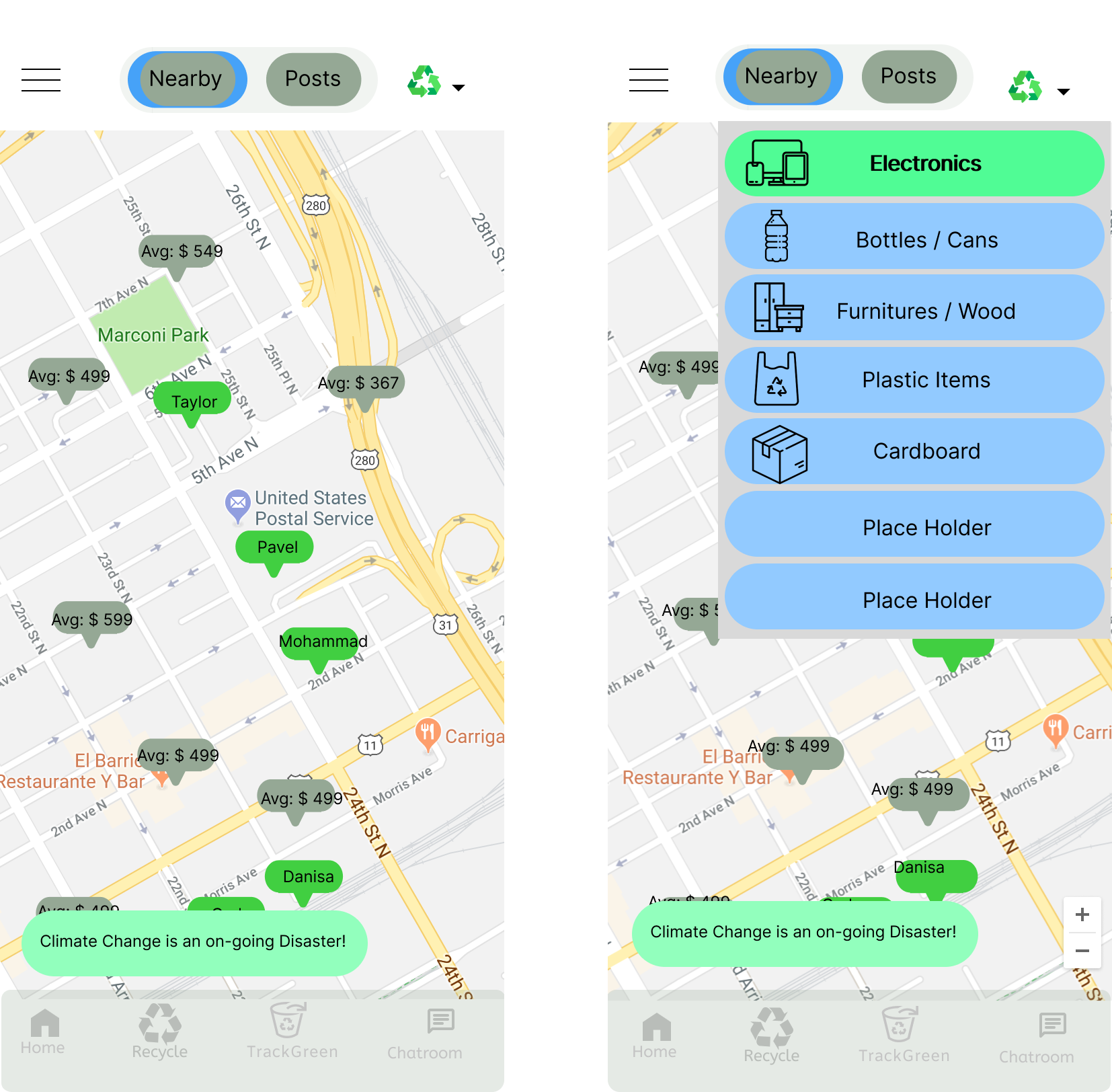
![https://cdn.sanity.io/images/7gp8xjn1/production/4d955bec95b7ff3dddbba3dc58b8f4322db1eba9-2048x1301.png"],["Habit](https://cdn.sanity.io/images/7gp8xjn1/production/4d955bec95b7ff3dddbba3dc58b8f4322db1eba9-2048x1301.png%22%5D,%5B%22Habit)
Map Screen:
This part of the app emphasizes both the recycling activities and illustrates a community of people who are trading away items at affordable rates while also providing information on climate change and Climate Change related events, which further enhances the awareness of climate change while using the app. According to Friedman (Friedman, 1996), this particular study concerns two values of a project, user autonomy and freedom. User autonomy is the actions of "individuals who are self-determining, who are able to decide, plan, and act in ways that they believe will help them to achieve their goals and promote their values.". User autonomy in our project is carefully taken into considerations. "Autonomy is protected when users are given control over the right things at the right time". Our project gives user all of the options for the user to choose freely: they can do recycle or not to do. However, in case they want motivation for doing them, we provide them with climate change disaster information as motivation; in case they want to recycle, we provide them with choices of recycling facilities; in case they want to do something else to help climate change disaster, we provide them with community gathering events.
Furthermore, the community gathering events not only benefit the ones who want to participate in the events to help climate change crisis (direct stakeholder) but also share the experience with the people who don't believe in climate change (indirect stakeholder) and learn the experience the ones who believe it.
What To Sell What To Buy:
This is another example of giving user the autonomy at the right time with the same theory from above.
Habit Tracking:
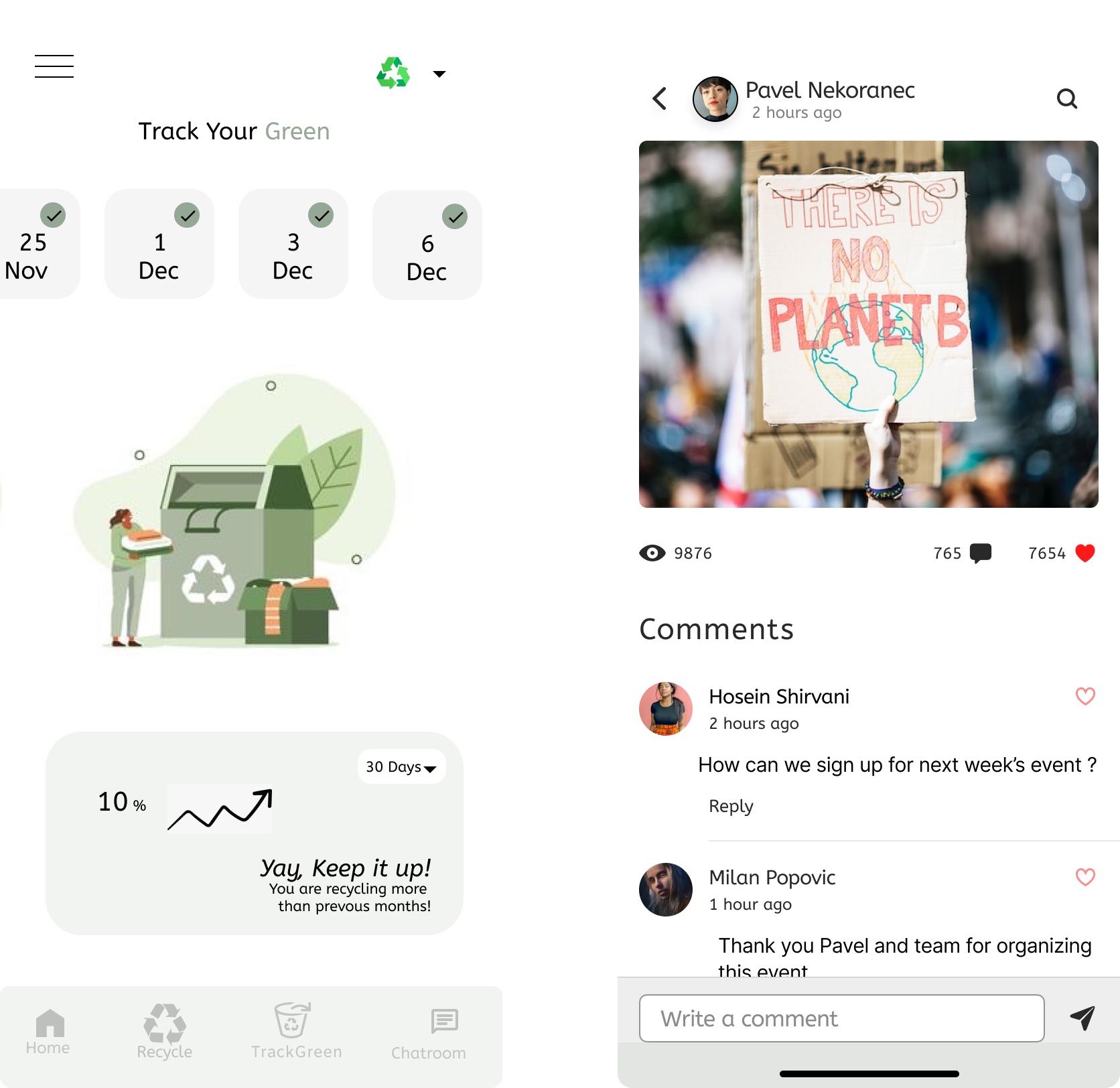
This app advises students on how to better reduce carbon footprints through their daily tracked habits. This feature illustrates a low pressure, friendly competitive (habit tracking percentage can be uploaded on social media platforms to compare with friends and motivate) human development being infused into the design process, which is something of value to university students, considering they are students since they choose to empower themselves via higher education.
Community Building:
Creating an app that not only connects student buyers and sellers, but also creates a community building opportunity through the rewards page where students can interact and learn more through open discussions on climate change, was one of our goals while working on this project. The values being put into consideration here are diversity and community, as recycling is not done in isolation but students from various backgrounds are able to connect with each other to trade items, and learn more about climate change from each other.
Mutual Collaboration:
The discussion pages also create an environment that allows students to come together and collaborate on climate change activities, which will in turn create more awareness on climate change. This feature illustrates diversity, sustainability, action, and welfare as students can come together on the Green Earth chat platform, creating collaborative space for students to organize, participate and contribute to Climate Change conversations, activities and events.
Students are not only saving funds by trading unwanted or unused items (financial value), but they get to: track their habits, learn about climate change within a community that will lead to relationships beyond climate change as well as daily information on how their activities affect their environments.
Contributions of Team Members
The report was divided evenly between Yusheng and Atinuke. We divided the report work based on division of research from the proposal stage. Yusheng mainly focused on the initial ideas of the product, product research, information relating to climate change and explain the details of our design decisions. Atinuke focused on the user group analysis and design decisions (Value sensitive design). For the research (i.e. looking for evidence and report on university students' behaviors) and prototyping, both of them have contributed to user group research and prototyping by working collaboratively through online meetings on Google meet and Figma.
The report was first written in draft, after that, they made their prototype and presentation collaboratively according to the key points from their report.
REFERENCES:
what-are-long-term-effects-climate-change
Cordero, E. C., Todd, A. M., & Abellera, D. (2008). Climate Change Education and the Ecological Footprint. Bulletin of the American Meteorological Society, 89(6), 865--872. https://doi.org/10.1175/2007BAMS2432.
Filho, W. L. (2010). Climate Change at Universities: Results of a World Survey. In W. Leal Filho (Ed.), Universities and Climate Change: Introducing Climate Change to University Programmes (pp. 1--19). Springer. https://doi.org/10.1007/978-3-642-10751-1_1
Iversen, N., Birkved, M., & Cawthorne, D. (2020). Value Sensitive Design and Environmental
Impact Potential Assessment for Enhanced Sustainability in Unmanned Aerial Systems. 2020
IEEE International Symposium on Technology and Society (ISTAS), 192--200. https://doi.org/10.1109/ISTAS50296.2020.9462210
Stimulating University Student Engagement in Climate Action. https://sustain.ubc.ca/sites/default/files/seedslibrary/GEOG_371_Stimulating%20University%20Student%20Engagement%20in%20Climate%20Action_FinalReport.pdf.